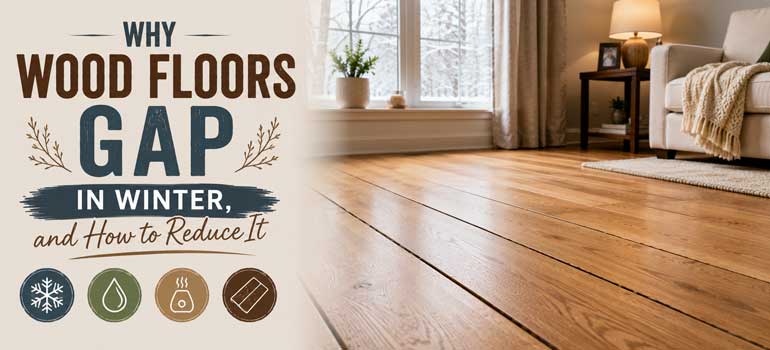
Small gaps opening between floorboards as the weather turns colder is one of the most common seasonal complaints from wood floor owners, and it's rarely a sign anything's gone wrong with the installation. Central heating dries the air indoors, wood loses moisture in response, and the boards contract slightly, small gaps are the visible result. Understanding why this happens makes it much easier to reduce, even if it can't always be eliminated.
Why heating specifically causes this
Wood is hygroscopic, meaning it absorbs and releases moisture in response to the surrounding air. In winter, running the heating lowers indoor humidity considerably, and the boards respond by shedding some of their moisture content and contracting slightly as a result. This is the same expansion-and-contraction cycle that runs in reverse during humid summer months, when boards can swell back, and gaps close up again, which is why many owners notice the effect is seasonal rather than permanent.
Why gaps matter beyond appearance
Beyond looking less tidy, gaps between boards create a few genuine practical downsides. Heat loss is one of the more overlooked ones, gaps can let warm air escape through the floor, undermining the insulation the flooring itself would otherwise provide and adding to heating costs during exactly the season you're trying to stay warm. Gaps also collect dirt, dust and debris that regular wood floor cleaning struggles to reach, and in some cases they contribute to the squeaking noise that develops as boards shift slightly against their fixings.
How installation choices affect how much a floor gaps
The way a floor is installed has a significant bearing on how much it moves each winter. Boards that were properly acclimatised to the room's conditions before fitting, given time to adjust to the space's humidity and temperature ahead of installation, generally move less predictably afterward than boards fitted straight from the supplier. Board width also matters: wider boards contract more in absolute terms than narrower ones, since there's simply more material moving proportionally, so narrower boards tend to show smaller, less noticeable gaps under the same humidity swing.
Choosing floor types and species that resist gapping
Engineered wood is generally the more dimensionally stable choice where indoor humidity swings are a known issue, its layered construction resists movement better than solid timber, making it a sensible option for properties that run dry in winter or where heating patterns are inconsistent. Species selection matters too: oak is comparatively resistant to changes in temperature and humidity, while beech is more sensitive and tends to show more noticeable seasonal movement. If gapping has been a recurring frustration, discussing species and construction type at the point of a new installation, or during a wood floor sanding and refit, is worth doing rather than assuming every wood floor will behave the same way.
Managing indoor humidity through the winter
The single most effective ongoing control is keeping indoor conditions within a stable range: 40 to 50% relative humidity and a temperature between 19 and 25°C gives most wood flooring the conditions it needs to stay dimensionally stable through the colder months. A humidifier during the driest winter weeks can meaningfully reduce gapping compared with running heating unmanaged, and it's a far simpler fix than addressing gaps after they've already opened.
When gaps need more than humidity management
Small, seasonal gaps that close up again in summer are normal and don't usually need any intervention beyond humidity control. Gaps that stay open year-round, or that have widened noticeably over several winters, are a different matter and may point to boards that were never properly acclimatised, or a species poorly suited to the property's conditions. In these cases, gap filling as part of a wider repair and refinish addresses the existing gaps directly, while adjusting humidity control going forward reduces how quickly new ones develop.
If your floor is gapping more than seems normal, or you'd like advice on species and construction choices for a property with known humidity challenges, get in touch for a free, no-obligation quote and we'll take a look.
Frequently asked questions
Do winter gaps always close up again in summer? Often yes, if the gaps are a normal seasonal response to humidity change. Gaps that persist or widen year after year suggest a different underlying issue worth having assessed.
Is engineered wood always better than solid wood for avoiding gaps? It's generally more dimensionally stable, which helps in properties with significant humidity swings, though solid wood with proper acclimatisation and the right species can still perform well.
What humidity level should I aim for indoors in winter? Roughly 40 to 50% relative humidity is the commonly recommended range for keeping most wood flooring stable, alongside a temperature between 19 and 25°C.
Can gaps be filled permanently, or will they just reopen? Filling addresses existing gaps effectively, but if the underlying humidity swings aren't managed, new gaps can still develop elsewhere as the seasons change.
Does board width really make a noticeable difference to gapping? Yes, wider boards move more in absolute terms with the same humidity change, so narrower boards generally show smaller, less obvious gaps under similar conditions.