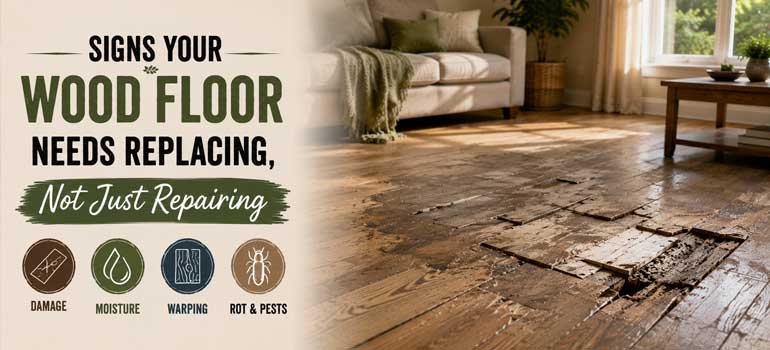
Most wood floor problems are fixable. Scratches, worn finish, small gaps and surface dents are exactly what sanding, repair and refinishing exist to address, and wood floor repairs are almost always considerably cheaper than replacement. The harder question is knowing which specific signs mean a floor has truly gone beyond what repair can fix, and those signs are worth being able to recognise before assuming the worst, or ignoring something that actually needs attention.
What usually causes floors to reach this point
Moisture is by far the most common root cause of damage severe enough to require replacement, whether from a slow leak, flooding, high indoor humidity, or repeated water exposure that was never properly addressed. Excessive traffic combined with a lack of regular maintenance is the other major contributor, since problems that would have been minor with early attention compound over years of neglect into something more serious.
Signs that generally mean replacement is needed
| Sign | What's happening | Why it's usually beyond repair |
|---|---|---|
| Boards lifting and cracking | Fixings have failed and the board has broken under stress | Cracked boards can't be structurally restored, though damaged sections can often be replaced individually |
| Cupping, bowing, sagging or bending | Moisture absorbed unevenly across the board's thickness | The wood's structure itself has been distorted, not just the surface |
| Large gaps between boards | Long-term humidity swings, or boards that have shrunk significantly | Gap filling works for small gaps; larger ones exceed what fillers can structurally support |
| Severe discolouration | Wood has aged well beyond normal colour maturation, or suffered prolonged UV exposure that's thinned and weakened it | Colour and structural integrity have both degraded together |
| Warping or swelling across sections | Extended moisture exposure affecting a wider area | The damage is distributed rather than isolated, making spot repair impractical |
The good news: most of what you'll actually notice is fixable
It's worth being clear that the list above represents the more serious end of wood floor problems, not the everyday wear most owners actually encounter. The following are all things sanding and refinishing handle routinely:
- Surface scratches and dents from foot traffic, furniture, or pets
- Smaller gaps between boards, filled successfully as part of a standard repair
- Uneven patches or minor bumps in the surface
- Worn or dulled finish, addressed with recoating or a full refinish depending on severity
- Chips and minor surface damage localised to specific spots
- Slight corrugation or unevenness across the boards
- Gradual, expected colour change from age and light exposure
If what you're seeing falls into this list rather than the more serious signs above, wood floor sanding is very likely the right and considerably cheaper option.
Why catching problems early makes such a difference
The gap between "easily repairable" and "needs replacing" is often a matter of time and neglect rather than the initial cause. A small gap left unaddressed for years can widen into something gap filling can no longer manage. A minor moisture exposure, cleaned up and dried promptly, might cause no lasting harm, while the same exposure left to sit can progress to cupping or warping. This is really the core argument for regular maintenance and prompt attention to small issues: it's not about avoiding all wear, which is impossible, it's about catching problems while they're still in the cheap-to-fix category.
Getting an accurate diagnosis
Because some of these signs can look similar from a distance, a board with a small localised gap versus one that's cupped across its whole width, it's worth getting a professional assessment rather than guessing based on appearance alone. A proper inspection can also distinguish between damage limited to a few boards, which might only need spot replacement, and a wider issue affecting the whole floor's structure. Getting this right avoids two costly mistakes: replacing a floor that could have been repaired, or repairing sections of a floor that actually needed full replacement.
If you're unsure which category your floor falls into, get in touch for a free, no-obligation quote and we'll assess it honestly rather than defaulting to the more expensive option.
Frequently asked questions
Can cupped or warped boards ever be saved without replacement? Occasionally, if caught early and the moisture source is resolved quickly, some minor cupping can improve as the wood dries out. Advanced cases usually require replacing the affected boards.
How do I know if a gap between boards is too big to fill? This depends on the specific gap width and the filling product used, which is why a professional assessment is more reliable than judging by eye alone.
Does discolouration always mean the floor needs replacing? No, gradual colour change from age and light exposure is normal and doesn't require replacement. Severe discolouration paired with thinning or weakened wood is the more serious sign.
Can I replace just the damaged boards instead of the whole floor? Often yes, particularly where damage is limited to specific boards or a small area. A full floor sand afterward helps blend replacement sections in with the rest.
Is it always obvious when a floor has moved from repairable to needing replacement? Not always. Some signs look similar to less serious issues from a distance, which is why a professional assessment is worth having before assuming either outcome.