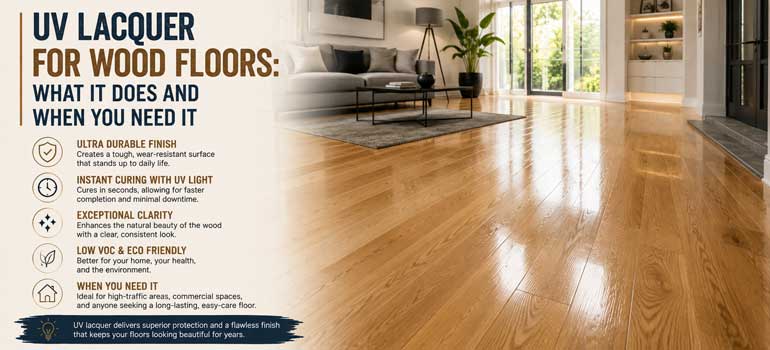
Most people know that direct sunlight fades curtains and furniture, but the same thing happens to wood floors, and it's a specific enough problem that a specific type of finish exists to prevent it. UV lacquer is worth understanding if any part of your floor sits in a sun-exposed room, particularly if the wood is a darker shade, since that's where sun damage shows up fastest and most visibly.
What sun exposure actually does to wood
Direct sunlight causes two related problems in wood flooring: it dries the surface out over time, and it changes the colour, usually fading darker woods toward a lighter, patchier tone. This isn't damage in the structural sense, the wood isn't weakened, but it is a genuine cosmetic problem, and an uneven one. Floors under rugs, furniture, or simply out of direct light stay their original shade, while the sun-exposed sections around windows and doors visibly lighten, creating a mismatched look across a single room that can be more noticeable than even wear from foot traffic.
How UV lacquer differs from standard sealants
Most sealing products, including Bona Traffic HD and other standard lacquers, are built primarily to guard against moisture, scratching, and general wear. UV lacquer does that too, but adds a specific layer of protection against ultraviolet light, slowing the rate at which sunlight dries and discolours the wood underneath. It isn't a different category of finish so much as a standard lacquer formulated with UV inhibitors added in, which means it can generally be applied wherever a normal lacquer would go, just with this extra layer of protection built in.
Why dark floors need it most
Colour fading from UV exposure is visible on any wood floor, but it's dramatically more noticeable on darker stains and species. A light oak floor that fades slightly is a subtle shift; a deep walnut or dark-stained floor that fades unevenly in patches is an obvious, often frustrating problem, since the contrast between faded and protected areas is much starker. If your floor has been stained to a darker tone, or you're planning a dark stain during an upcoming wood floor staining project, UV lacquer is worth specifically asking about rather than assuming a standard finish will do.
Signs your floor might already need it
A few tell-tale signs suggest UV damage has already started, and are worth checking for before assuming a floor's dulling is purely down to foot traffic and dirt.
- A visibly lighter patch near windows, patio doors, or skylights compared to the rest of the room
- An outline left by a rug or furniture that's been moved after sitting in one spot for a long time, since the covered area keeps its original colour while everything around it fades
- A drier, slightly chalky texture on the surface in consistently sun-exposed areas
- Colour that looks uneven across the room even though the wood species and original stain were the same throughout
If any of these sound familiar, sanding and refinishing with UV lacquer can even out the colour and prevent the problem recurring, rather than just living with an increasingly obvious mismatch.
Getting UV lacquer applied
UV lacquer isn't a standalone treatment; it goes on as part of the normal wood floor sanding and finishing process, applied in the same way as a standard lacquer once the floor has been sanded back to bare wood. If you're already planning a sand for other reasons, worn finish, scratches, general dulling - it's a straightforward addition to specify at that point rather than a separate project. It's also worth considering for any room getting new blinds, curtains, or window treatments removed, since a change in how much direct sun reaches the floor is exactly when uneven fading tends to start.
If your floor has patchy fading from sun exposure, or you're planning a dark stain in a sunny room, get in touch for a free, no-obligation quote and we'll talk through whether UV lacquer makes sense for your specific floor and room.
Frequently asked questions
Does UV lacquer completely stop a floor from fading? It significantly slows fading rather than eliminating it, since ongoing UV exposure will always have some cumulative effect over years. It's a meaningful reduction, not a permanent guarantee.
Can UV lacquer be applied to a floor that already has a standard finish? Generally, the floor needs to be sanded back to bare wood first, since UV lacquer is applied as part of the finishing process rather than layered directly over an existing sealant.
Is UV lacquer only worth it for dark-stained floors? Dark floors show fading most dramatically, but any floor in a consistently sun-exposed room can benefit, particularly where rugs or furniture create visible colour contrast over time.
How can I tell if my floor already has UV protection? This usually isn't visible by eye. If you're unsure what finish was used previously, a professional can check during an assessment, or you can ask whoever originally fitted or refinished the floor.
Does UV lacquer cost more than a standard finish? It's a specialised product, so it typically costs more than a standard lacquer, but for sun-exposed rooms with dark flooring, it's often worth the difference to avoid uneven fading down the line.