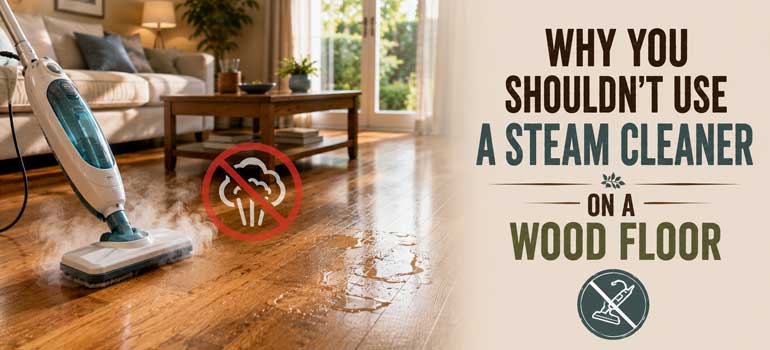
Steam cleaners are marketed as a fast, chemical-free way to clean almost any hard floor, and some brands do specifically list wood as suitable. Despite that, steam cleaning is one of the more damaging things you can do to a solid or engineered wood floor, and the reasons come down to two things steam cleaners produce by design: heat and moisture, exactly what wood is most sensitive to.
Why moisture is the core problem
The single most important rule in wood floor care is minimising water contact entirely, and a steam cleaner works directly against that. Even though steam looks and feels different from a wet mop, it still deposits moisture onto and into the floor's surface. Wood is a naturally porous material, and over repeated use, that absorbed moisture accumulates in the boards. The result is swelling, as the wood physically expands with the moisture it's taken on, and once boards have nowhere to expand into, they push upward, a process known as cupping or buckling, which is difficult and often expensive to reverse.
Heat adds a second layer of risk
Beyond the moisture itself, steam cleaners also raise the surface temperature of the floor as they work, and for floors bonded to the subfloor with adhesive, that heat carries its own risk. Wood glue and adhesive can be affected by sustained heat exposure, and where that bond weakens, boards can come loose from the subfloor entirely. This is a particular concern for engineered floors and parquet, which are more commonly glued down than solid boards fixed with nails or screws, though the moisture risk applies to every wood floor type regardless of how it's fitted.
Why marketing claims can be misleading
Some steam cleaner manufacturers do market their products as safe for sealed hardwood, and this claim isn't entirely baseless, a very light, controlled steam application on a well-sealed floor, used briefly and infrequently, may cause less obvious damage than heavier or repeated use. But the risk profile still doesn't favour steam over safer alternatives: the margin for error is small, damage often isn't visible immediately, and by the time swelling or cupping becomes noticeable, the moisture has already done its work. Given how easy it is to clean a wood floor thoroughly without introducing any of this risk, steam simply isn't worth it.
What to use instead for a thorough, fast clean
A few tools and approaches get a deep clean without the moisture risk steam carries.
- A vacuum with a hard-floor attachment, not a beater-bar brush, lifts embedded dirt and grit effectively without any liquid involved
- A microfibre dry mop picks up fine dust and debris that sweeping alone can miss, and works well as a quick pre-guest clean
- A barely damp mop with a wood-appropriate cleaner, wrung out thoroughly rather than left wet, handles marks and light grime without saturating the surface
- Spot cleaning with a slightly damp cloth for specific marks or spills is more controlled than any whole-floor liquid method
Combined, these cover everything a steam clean promises to do, dust, grime, and light marks, without the swelling risk.
If damage has already happened
If a floor has already been steam cleaned and you're noticing early signs of trouble, boards that feel slightly raised at the edges, a section that looks uneven compared to the rest of the room, or visible gapping that's appeared since, it's worth having it assessed sooner rather than later. Early-stage moisture damage sometimes settles back down once the wood dries out fully, but more advanced cupping or buckling generally needs professional attention. Wood floor sanding can address moderate cases once the moisture issue itself has been resolved, and our floor repair service can assess boards that have lifted or come loose.
If you're not sure whether your floor has been affected, or you'd like advice on a safe cleaning routine going forward, get in touch for a free, no-obligation quote and we'll take a look.
Frequently asked questions
Are any steam cleaners actually safe for wood floors? Manufacturer claims vary, but the risk of moisture and heat damage remains even with products marketed as wood-safe, and the potential consequences are significant enough that we don't recommend it regardless of the brand.
How quickly does steam cleaning damage show up? Not always immediately. Moisture absorption and its effects can take time to become visible, which is part of why the risk is easy to underestimate until swelling or gapping appears.
Can a floor recover from mild steam cleaner damage? Very early-stage moisture absorption sometimes resolves once the wood fully dries out, but visible cupping, buckling or loosened boards usually need professional assessment and repair.
Is engineered wood more at risk from steam than solid wood? Both are vulnerable to moisture damage, but engineered floors and parquet are more commonly glued down, adding an adhesive-weakening risk from heat exposure that solid, nailed floors are less likely to face.
What's the fastest way to deep clean a wood floor without steam? A vacuum with a hard-floor attachment followed by a barely damp mop with a wood-appropriate cleaner gets a thorough result quickly, without introducing the moisture risk steam carries.