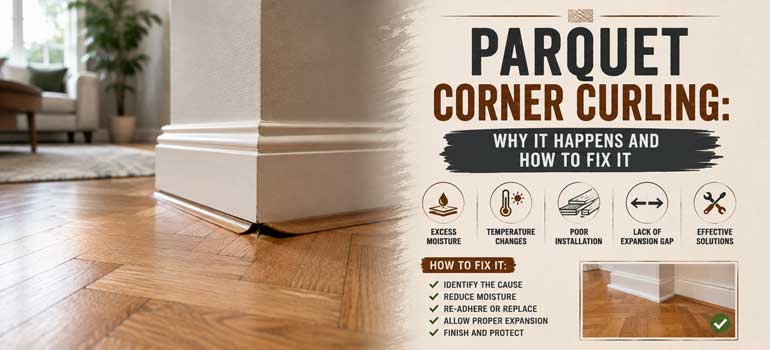
Curled or lifted corners on parquet blocks are one of the more puzzling problems a wood floor can develop, since it often shows up on floors that look otherwise fine, with no obvious moisture problem, no failed adhesive, and nothing wrong with the installation itself. In a case we investigated on a 6.5cm-wide oiled parquet floor laid using the tongue and groove method, the cause turned out to be something most people wouldn't think to check: the direction of the wood grain relative to the block's corners.
What causes corner curling
The affected corners in this case were consistently the ones sitting on the diagonal, perpendicular to the grain, not the corners running parallel to the block edges. On inspection, the core of the flooring had split along that diagonal line, and this splitting was the direct cause of the curling. Notably, the usual suspects weren't the culprit: room humidity was within a normal range, there had been no extensive drying period, and moisture readings in the upper layer of the flooring came back normal too. The pattern of the parquet itself was standard. What was unusual was purely the grain direction relative to the groove.
This distinction matters because it changes where stress concentrates in each block:
- Elements parallel to the block edges were more resistant to movement and held up well
- Elements running diagonal to the grain were noticeably less durable and more sensitive to drying, since wood is naturally weaker across the grain than along it
The groove cut into these particular blocks was 6.5mm, and its rectangular shape concentrated stress at the upper part of the groove precisely where the grain ran diagonally. In effect, the groove design and the grain direction combined to create a structural weak point that had nothing to do with moisture or workmanship.
Why this matters beyond one specific floor
Corner curling isn't always caused by grain and groove geometry the way it was in this case; it can also result from more familiar causes like a damp subfloor, blocks that weren't fully bonded during installation, or normal seasonal humidity swings causing the wood to move. The reason this particular case is worth understanding is that it shows curling can happen even when every obvious cause has been ruled out, which means diagnosing the actual root cause matters more than reaching for the most common explanation. A curling problem caused by grain direction needs a different long-term fix than one caused by moisture, even though the visible symptom looks the same.
How to repair curled or split corners
For an isolated split, small holes can be drilled into the affected area and the crack glued with resin, which stabilises the block without pulling up the whole floor. This is a genuine fix, though it's worth being upfront that it won't always be invisible; the repaired area can sometimes remain slightly visible even once finished. Where curling has affected a significant portion of the floor, or where the underlying cause is a systemic groove and grain issue across many blocks rather than one or two, a full or partial reinstallation may be the more practical long-term solution rather than repairing block by block.
Preventing the problem in future installations
If you're planning a new parquet installation, or having an existing one replaced after a curling problem, it's worth discussing groove depth and grain orientation with your installer rather than assuming standard specifications will suit every layout. Shallower grooves reduce the concentration of stress at points where grain direction and groove geometry might otherwise combine against the wood, and this is a detail worth raising specifically if your chosen pattern includes blocks running diagonally.
If you're seeing curled or lifted corners on a parquet floor, our floor repair service can assess whether it's a localised fix or a wider issue, and we can advise on reinstallation where that's the better long-term option. Get in touch on 020 70360625 or request a free, no-obligation quote and we'll take a look.
Frequently asked questions
Is corner curling always caused by moisture? No. While moisture is a common cause, curling can also result from grain direction and groove geometry interacting under normal conditions, as seen in cases where humidity and moisture readings were entirely normal.
Can a curled parquet corner be repaired without replacing the block? Often yes. Small holes can be drilled and the split glued with resin to stabilise the corner, though the repair may remain slightly visible depending on the extent of the damage.
Does the width of the parquet block affect how likely it is to curl? Block width itself isn't the deciding factor; the direction of the grain relative to the groove and the block's edges plays a bigger role in where stress concentrates.
Should I be worried if only a few corners on my parquet floor are curling? A small number of isolated cases can usually be repaired individually. Widespread curling across many blocks is worth having assessed to identify whether there's a systemic cause.
Can this problem be prevented in a new installation? Yes, largely. Choosing shallower grooves and discussing grain orientation with your installer, particularly for diagonal or angled patterns, reduces the risk of this specific type of stress-related curling.