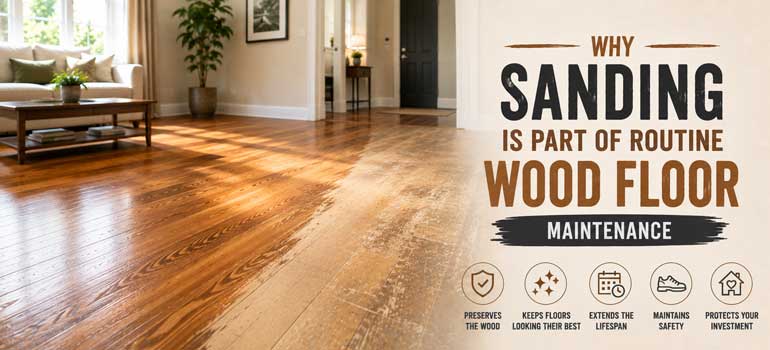
Wood flooring is low-maintenance day to day, but "low-maintenance" doesn't mean "no maintenance ever." A good weekly routine keeps a floor looking its best between the occasional deeper treatment that only sanding can provide. Understanding how the two fit together, daily care and periodic sanding, is what actually keeps a wood floor in good condition for decades rather than years.
The everyday routine that protects a floor
Most of what a wood floor needs day to day is simple and doesn't require special products:
- Vacuum with a hard-floor attachment or sweep with a soft-bristled broom to clear grit before it gets ground into the finish underfoot
- Mop with a barely damp mop, never a wet one, since standing moisture is one of the fastest ways to damage a wood surface
- Wipe up spills immediately rather than letting them sit, particularly on oiled finishes which are more absorbent than lacquered ones
- Use furniture pads under chair and table legs to stop scuffing and dents from everyday movement
This routine slows down wear considerably, but it doesn't stop it entirely, and that's where sanding comes in.
When sanding becomes necessary
Even with careful daily care, a wood floor will eventually show wear: dulling in high-traffic paths, fine scratches building up over the years, small dents from dropped objects, and occasionally gaps opening between boards as humidity changes through the seasons. None of this means the floor has been neglected; it's the expected result of years of use, and it's exactly what sanding is designed to reset. Solid wood floors can typically be sanded up to 6 to 7 times over their lifetime, depending on how thick the original boards are, which is a significant amount of restoration available across a floor's life.
Why different floor types need different sanding approaches
Not every wood floor is sanded the same way, and this is one area where a professional assessment matters more than it might seem.
| Floor type | Sanding consideration |
|---|---|
| Solid wood | Full-depth timber, most forgiving of repeated sanding over its lifetime |
| Engineered wood | Thin real-wood veneer over a plywood base, easily sanded through if not handled carefully |
| Parquet | Grain runs in different directions block to block, risking a patchy finish and loss of the pattern if sanded incorrectly |
Engineered floors in particular are easy to damage in DIY hands, since the veneer that can be sanded is often only a few millimetres thick, and once it's gone there's no way to sand the floor again.
How humidity affects how often a floor needs sanding
This is worth knowing beyond the basic cleaning routine: indoor humidity has a direct effect on how much a wood floor moves, and floors in rooms with big humidity swings, near kitchens, bathrooms, or in older properties without consistent heating, tend to show gaps and surface stress sooner than floors in more stable environments. Keeping indoor humidity relatively consistent, avoiding extremes of very dry heating in winter and high humidity in summer where possible, genuinely extends the time between sands, because much of what drives boards to gap and cup is moisture movement rather than foot traffic alone.
Sanding as prevention, not just restoration
Treating small imperfections while they're still small is what keeps a floor from developing bigger, more expensive problems later, loose boards, deep structural scratches, and persistent squeaking are all things that get harder and more costly to fix the longer they're left. Sanding right before sealing and staining also makes practical sense: freshly sanded wood has open pores that absorb finish evenly, while staining over an unsanded surface tends to highlight every existing imperfection instead of hiding it.
If your floor is starting to show wear despite a good cleaning routine, our floor maintenance service covers the ongoing side of floor care, and wood floor sanding handles the deeper restoration when it's time. Get in touch for a free, no-obligation quote and we'll assess what your floor actually needs.
Frequently asked questions
How often should a wood floor be sanded? This varies by usage, but many solid wood floors need sanding roughly every 7 to 10 years. High-traffic areas or busier households may need it sooner.
Does regular cleaning reduce how often sanding is needed? Yes, keeping grit off the floor and dealing with spills quickly slows down surface wear, which extends the time between sands, though it won't eliminate the need for it entirely.
Can engineered wood floors be sanded as safely as solid wood? They need more care. The real-wood veneer on engineered floors is much thinner than a solid board, so a professional assessment is worth having before sanding to avoid sanding through it.
Does indoor humidity really affect how often a floor needs sanding? Yes. Significant humidity swings cause more board movement, gapping and surface stress, which can bring forward the point at which a floor needs sanding.
Is it normal for a wood floor to develop small gaps between boards? Yes, this is a normal response to seasonal humidity changes rather than a sign of poor quality. Gaps can be addressed during a sanding and repair service.