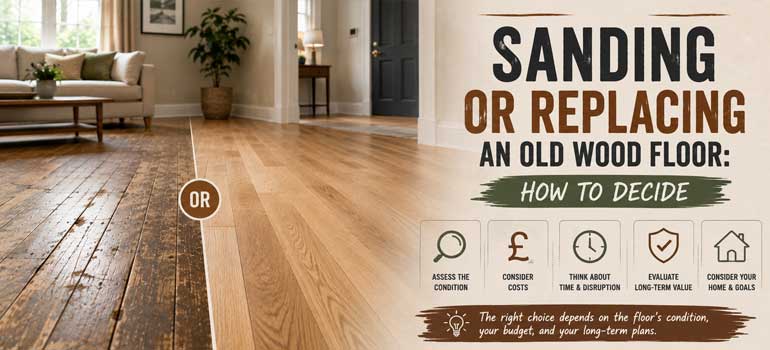
Replacing a worn wood floor is often the first thing people consider, but it's rarely the only option, and it isn't always the right one. Most old, tired-looking wood floors have more life left in them than they appear to, and sanding can bring back a floor that looks close to unsalvageable. The real question isn't sanding versus replacing in the abstract; it's what condition your specific floor is actually in.
Why wear doesn't automatically mean replacement
All wood floors change over time. Nobody buys one expecting it to look identical forever, but the speed and type of wear can still catch owners off guard, especially if a maintenance routine hasn't kept pace with how the floor is actually used. The good news is that most of what makes an old floor look tired, surface scratches, small non-structural gaps, staining, dirt build-up, discolouration, and years of worn finish - is exactly what sanding is designed to fix. Sanding strips away all of that surface-level damage and, combined with sealing and staining, can leave a floor looking better than its original condition, with a smoother, more even finish and stronger colour contrast than it had when new.
What a professional assessment actually checks
Before recommending sanding or replacement, a proper inspection looks at more than just how the floor looks on the surface:
- Board condition, checking for cracking, splitting, or boards that have cupped or warped beyond what sanding can level out
- Structural soundness, including whether boards are securely fixed or have significant movement
- Remaining wood thickness, since a floor that's already been sanded several times may not have enough material left for another safe sanding
- Extent of the damage, distinguishing between a few problem areas and damage spread across most of the floor
- Subfloor condition, particularly where moisture or historic water damage might be involved
This assessment is what actually determines the right path, not a general rule of thumb based on the floor's age alone.
When sanding is the right call
Sanding works well on floors with surface-level wear, however extensive it looks, as long as the boards themselves are structurally sound and haven't already been sanded down to their safe minimum thickness. A floor that's scratched, dulled, stained, or has small gaps between boards is almost always a sanding candidate, even if it's been years since it was last treated. Even quite severely worn floors can often be brought back, since sanding removes a genuine layer of material rather than just cleaning the surface.
When replacement genuinely makes more sense
Replacement becomes the more sensible option when the damage goes beyond what sanding can address: broken, cracked or missing boards across a large portion of the floor, boards that have already reached their sanding limit from repeated treatments over the decades, or structural issues in the floor itself rather than just the surface. Where damage is limited to specific areas rather than spread throughout, spot repairs and localised board replacement, followed by sanding the whole floor to blend everything, is often a middle ground that avoids a full replacement while still fixing the worst-affected sections.
The cost and disruption difference worth knowing
Beyond the condition of the boards themselves, it's worth factoring in that sanding and replacement are very different projects in scope. Sanding works with the floor that's already there, typically taking a matter of days and leaving the existing character of the wood intact, including any age-related grain and colour variation many owners actually want to keep. Full replacement means lifting the old floor, disposing of it, and installing new material entirely, which is a longer and more disruptive project and loses whatever character the original floor had built up over its life. For period properties in particular, this is often the deciding factor: a floor sanded back to bare wood keeps its original grain and patina in a way new flooring simply can't replicate.
If you're not sure which category your floor falls into, our floor sanding team can assess it properly before recommending anything, and our floor repair service handles localised fixes where a full sand isn't yet necessary. Get in touch for a free, no-obligation quote and we'll give you an honest answer either way.
Frequently asked questions
Can a very old, heavily worn floor still be sanded? Often yes. Age and surface wear alone rarely rule out sanding, as long as the boards are structurally sound and haven't already reached their safe sanding limit.
How do I know if my floor has been sanded too many times already? This requires a professional assessment of the remaining wood thickness, since it isn't visible just by looking at the surface. A flooring specialist can check this before recommending further sanding.
Is spot repair a realistic alternative to full replacement? Yes, where damage is limited to specific areas. Replacing the affected boards and then sanding the whole floor together is often enough to avoid a full replacement.
Is sanding cheaper than replacing a floor? Sanding generally involves less material, less disposal, and less disruption than a full replacement, though the right comparison depends on the specific floor's condition.
Does sanding remove the character of an old floor? No, sanding preserves the existing grain and character of the wood while removing surface wear, which is one of the main reasons owners of period properties choose it over replacement.