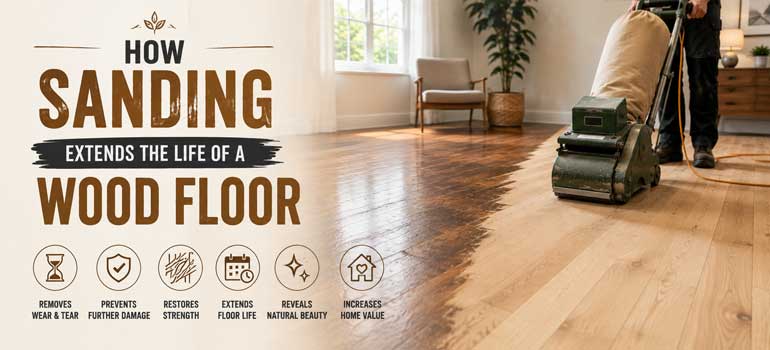
Wood floors have a genuine advantage over most other flooring materials: they can be restored rather than replaced. Sanding is the part of that process that does the actual work, removing the worn top layer of finish and wood so a fresh, even surface is left underneath. How much life sanding adds, and how often it can be done, depends heavily on what type of wood floor you actually have.
How often each floor type can be sanded
| Floor type | Typical wear layer | Realistic number of sands over its lifetime | Notes |
|---|---|---|---|
| Solid wood | Full thickness board, usually 18–22mm | 4–8 times | Can often be sanded for well over a century of use with proper care |
| Engineered wood | Real wood veneer, typically 2–6mm, over a plywood base | 1–3 times, sometimes not at all on thinner veneers | Once the veneer is gone, sanding isn't possible without exposing the base layer |
| Parquet | Individual solid blocks, thickness varies by original cut | 3–6 times | Block thickness and grain direction both limit how much can safely be removed at once |
Why unfinished wood floors need sanding from the start
Unfinished floors are sold without any factory-applied lacquer or oil, which keeps the price down and lets the owner choose their own finish and colour once it's installed. But bare, untreated wood isn't ready to be walked on as-is. Sanding at installation opens the wood's pores evenly across the whole floor, so stain and finish absorb consistently rather than patchily, and it levels out any minor manufacturing inconsistencies in the boards before the first coat goes on. Skipping this step is the most common reason a newly installed unfinished floor ends up with an uneven, blotchy first finish.
What sanding fixes, and what it doesn't
Sanding is very effective at removing surface-level problems: worn finish, shallow scratches, light staining, and general dulling from years of foot traffic. It is not a fix for everything, and it's worth knowing the difference before booking a service expecting more than sanding can deliver:
- Loose or broken boards need repair or replacement before sanding, not instead of it
- Active woodworm or rot are structural and biological problems that sanding doesn't treat; they need pest control or timber repair first
- Deep water damage that has cupped or warped boards may need boards replaced rather than sanded flat
- Squeaking floors are usually a subfloor or fixing issue, not something the surface finish causes
Sanding does prevent existing surface wear from getting worse, which is a meaningful part of long-term floor care even though it isn't a cure-all.
Maintenance sanding versus full restoration
Not every sand needs to remove the same amount of material. A light maintenance sand, sometimes called a screen and recoat, lightly abrades the existing finish and adds a fresh top coat without cutting into the wood itself; it's a good option for a floor that's just lost its shine but hasn't got deep scratches or bare patches. A full sand removes the old finish entirely along with a thin layer of wood, and is needed once there are deep scratches, gaps, or areas where the wood is exposed. Choosing the lighter option when it's genuinely enough is what allows a floor to be sanded more times over its life, since each full sand uses up some of the wood's total sandable thickness.
Getting the most sanding life out of your floor
A few habits make a real difference to how long a floor can go between sands and how many sands it has left in it: using furniture pads under chair and table legs, keeping grit and dirt off the floor with regular sweeping or vacuuming (grit is abrasive and wears finish faster than foot traffic alone), and addressing spills before they sit long enough to damage the finish. None of these replace sanding, but they slow down how quickly a floor needs it again.
If you're not sure whether your floor needs a light maintenance sand or a full restoration, our floor sanding team can assess it and recommend the right level of work, and our floor maintenance service covers the lighter, ongoing side of floor care between full sands. Get in touch for a free, no-obligation quote.
Frequently asked questions
How do I know if my floor needs a light sand or a full sand? If the finish has dulled but the wood itself is still protected with no bare or scratched-through patches, a light maintenance sand is usually enough. Visible bare wood, deep scratches, or staining generally need a full sand.
Can engineered wood floors be sanded as many times as solid wood? No. Engineered floors have a thin real-wood veneer over a plywood base, so they can typically only be sanded once to three times before the veneer runs too thin to sand again safely.
Does sanding fix squeaking floorboards? No, squeaking is usually caused by movement in the subfloor or loose fixings, not the surface finish. This needs to be addressed separately, often before sanding.
Will sanding remove woodworm damage? No. Sanding only affects the surface layer of the wood. Active woodworm needs treatment, and any structurally weakened boards need repair or replacement.
How long can a well-maintained solid wood floor realistically last? With appropriate sanding roughly every 7 to 10 years and good day-to-day care, a solid wood floor can often be sanded and refinished for well over a century before running out of sandable material.