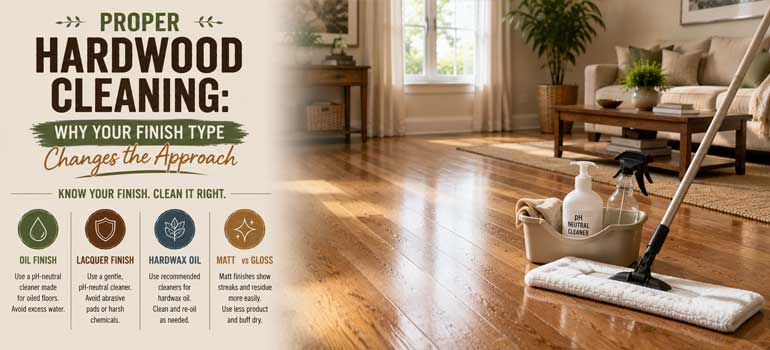
Most modern hardwood flooring leaves the factory with a urethane finish, a hard, film-forming coating that behaves quite differently from the wax and oil finishes common on older or site-finished floors. Knowing which type you have isn't a minor detail, it changes what products are safe to use and how the floor should be cleaned day to day, which makes identifying it the genuine first step before any routine gets set.
Why urethane finish is now the most common type
Urethane, a durable synthetic coating applied and cured at the factory, became the standard for most newly manufactured hardwood because it offers strong, consistent protection straight out of the box without needing on-site finishing. If your floor is relatively recent and came prefinished, there's a good chance it's urethane-coated. Older floors, or those finished after installation, are more likely to carry a wax or oil finish instead, and this distinction is worth confirming before settling on a cleaning routine.
Caring for a urethane-finished floor
| Task | What to do | Why it matters |
|---|---|---|
| Entrance protection | Interior and exterior doormats, plus rugs in busier areas | Reduces grit tracked in, which otherwise scratches the sealed surface |
| Rug backing | Avoid rubber or vinyl-backed rugs | These trap moisture against the finish and can cause discolouration over time |
| Daily dust removal | Sweep, dust mop, or vacuum with a hard-floor attachment | Loose dirt acts abrasively underfoot if left to build up |
| Spills | Wipe up immediately | Even a sealed finish can stain if liquid sits long enough |
| Cleaning products | Neutral pH, wood-specific cleaners only | Ammonia and abrasive products can dull or damage the urethane coating |
| Water | Damp mop only, never steam or standing water | Urethane resists moisture better than wax or oil, but excess water can still penetrate at seams and edges |
| Sunlight | Curtains, blinds, or UV-filtering finish where relevant | Slows colour fading, particularly on darker floors |
Why wax and oil floors need a different routine
Wax and oil finishes work by sitting in or on the wood itself rather than forming a hard synthetic film, which means they're more absorbent and more sensitive to certain cleaning products than urethane. A cleaner formulated for a sealed urethane surface can behave quite differently on an oil-finished floor, sometimes stripping or dulling the finish rather than cleaning it effectively. If you're not certain which finish your floor has, checking with whoever installed or last serviced it is worth doing before choosing a product, since the wrong match undermines the finish's performance even without causing immediate visible damage.
Getting a floor guest-ready quickly
If you're expecting visitors and want the floor looking its best without a lengthy deep clean, a fast but effective routine covers the essentials: a thorough sweep or vacuum to lift grit and dust, a damp mop with the appropriate cleaner for your specific finish, and a quick check for any recent spills or marks that might need spot attention. This kind of quick refresh works well as regular maintenance too, not just before entertaining, since it addresses exactly the buildup that causes long-term wear if left unattended.
When cleaning alone isn't enough
Even a well-maintained urethane, wax, or oil finish eventually shows wear that cleaning can't reverse: dulling across high-traffic paths, fine scratching that's built up over years, or staining that's worked past the finish into the wood itself. At that point, wood floor polishing can refresh a finish that's just lost its shine, while more significant wear calls for wood floor sanding to reset the surface entirely.
If you're not sure which finish your floor has, or your current routine isn't keeping it looking its best, get in touch for a free, no-obligation quote and we'll advise on the right approach for your specific floor.
Frequently asked questions
How can I tell if my floor has a urethane finish? Urethane gives a consistent, hard-wearing sheen and is common on floors manufactured and prefinished in recent years. If you're unsure, checking with the manufacturer, installer, or a professional inspection can confirm it.
Can I use the same cleaner on urethane and oil-finished floors? No, they need different products. A cleaner designed for a sealed urethane surface may not suit an oil finish, and using the wrong one can dull or damage the finish over time.
Is urethane more water-resistant than wax or oil? Generally yes, urethane's hard film gives better resistance to moisture at the surface, though excess water can still cause problems at board edges and seams regardless of finish type.
Does urethane finish ever need recoating like wax does? Urethane is more durable and typically needs less frequent attention than wax, but it still wears over years of use and will eventually need a full sand and refinish rather than a simple recoat.
What's the fastest way to get a hardwood floor looking presentable before guests arrive? A thorough sweep or vacuum followed by a damp mop with the right cleaner for your finish covers most of what's needed, plus quick spot treatment of any recent marks or spills.