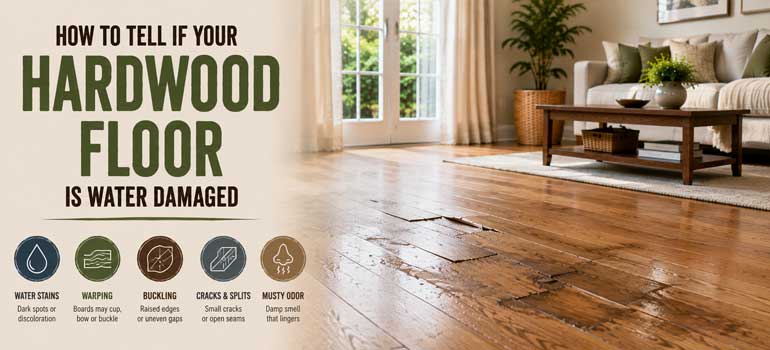
Water damage doesn't always announce itself the way a scratch or a dent does. Wood is porous, so moisture can work its way into boards gradually, staying hidden for weeks or months before the visible signs - warping, dulled finish, or cracking - finally show up. By the time it's obvious, the damage has often had time to spread further than it would have if caught earlier, which makes knowing what to check for worth the effort.
Why wood reacts so strongly to water
Real wood is a porous, living material even after it's milled into flooring boards, and that porosity is exactly what makes it vulnerable to moisture. Water absorbed into a board causes it to expand, and when the moisture leaves, it contracts again, that repeated movement is what leads to cupping, warping, and eventually loose or broken planks if the exposure continues or recurs. Understanding this helps explain why water damage isn't always sudden: a small, repeated moisture source can do as much long-term harm as one significant flood.
Visible signs to check for
A visual inspection is the first and easiest step, and a few specific things are worth looking for across the whole floor, not just the area you suspect might be affected.
- Warped or bent sections, where boards no longer sit flat against each other
- A dulled, cloudy finish, particularly in a specific area rather than uniformly across the room
- Cracking or splitting in individual floorboards
- A greyish residue left on a cloth if you wipe a wax-finished floor, indicating the wax has been compromised by moisture
- Visible cupping, where board edges sit higher than the centre, creating a shallow dish shape across each plank
Checking beyond what's visible
If nothing's obviously wrong to the eye but you suspect a problem, a hands-on check goes further than looking alone. Run your hand across the surface, feeling for warping or misshapen sections that might not catch the light in an obvious way. Persistent dampness underfoot, a section that feels cool or slightly damp compared to the rest of the room, is a stronger sign that moisture has already seeped into the boards rather than just affecting the surface finish.
Smell is often the earliest warning sign
A mouldy or musty odour coming from the floor is one of the clearest indicators that moisture has been present long enough for mould or mildew to establish itself, and it's often noticeable before any visual signs appear. Dark, poorly ventilated corners of a room are worth checking specifically, since they're more prone to trapped moisture and slower drying than open, well-aired areas.
What to do once you've spotted signs of water damage
Acting quickly changes the outcome here. If the source of moisture is still active, a slow leak, condensation, or an ongoing damp issue, resolving that comes first, since continuing to dry and refinish a floor with an unresolved moisture source is treating the symptom rather than the cause. Once the source is addressed, wood floor repairs can assess whether affected boards need replacing or whether the damage is limited enough for sanding and refinishing to correct.
Preventing future water damage
For floors in rooms with a higher risk of moisture, kitchens, bathrooms, conservatories, or properties with a history of damp, a moisture-proof membrane underlay fitted before installation adds a real layer of protection, insulating the boards from a damp subfloor and reducing how much moisture reaches the wood in the first place. This is worth discussing at the point of new installation or a full wood floor sanding and refit, rather than something to consider only after damage has already occurred.
If you suspect water damage but aren't certain, a professional inspection is worth having before deciding on next steps, since correctly identifying the extent of the damage determines whether repair or replacement is the right call. Get in touch for a free, no-obligation quote and we'll assess your floor properly.
Frequently asked questions
Can water damage be present without any visible signs? Yes, early-stage moisture absorption can be present in the wood before warping, dulling or cracking become visible, which is why a hands-on check and attention to smell are worth doing alongside a visual inspection.
Is a musty smell always a sign of mould? A persistent musty odour usually indicates mould or mildew growth from prolonged moisture exposure, though the exact cause is worth confirming with a professional inspection.
Can cupped boards return to normal once they dry out? Sometimes, if caught early and the moisture source is resolved quickly, minor cupping can improve as the wood dries. More advanced cases usually need professional assessment and possible board replacement.
How can I prevent water damage in a moisture-prone room? A moisture-proof membrane underlay fitted beneath the boards during installation significantly reduces how much moisture reaches the wood from a damp subfloor.
Should I try to sand out water damage myself? It's best to have a professional assess the extent of the damage first, since sanding over unresolved moisture issues, or boards that need replacing rather than sanding, won't fix the underlying problem.