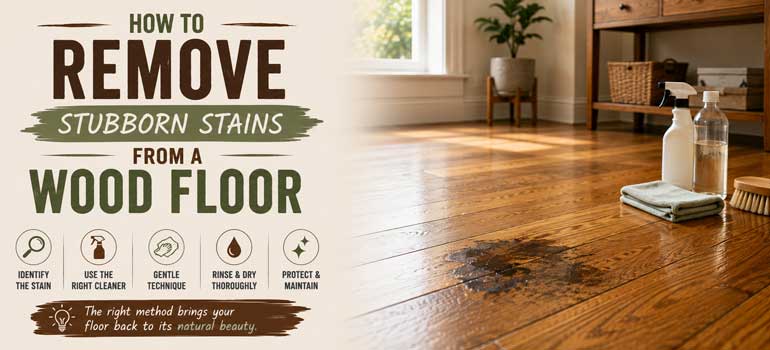
Every day dirt comes off a wood floor with a quick vacuum and a barely damp mop, but stains are a different problem entirely. Spilt wine, a water ring left by a glass, pet accidents - they all behave differently depending on how deep they've gone into the wood, and treating them the wrong way can do more harm than the stain itself. Knowing what you're dealing with before reaching for a cloth makes a real difference to the result.
Surface stains versus stains that have penetrated
The single most important thing to work out before treating any stain is whether it sits in the finish layer or has gone through to the bare wood underneath. A surface stain sits in the protective lacquer or oil and can usually be treated without disturbing the wood itself. A penetrated stain has gone past that layer into the timber, and no amount of surface cleaning will fully shift it, at that point, wood floor sanding down to bare wood is usually the only genuine fix. Pressing gently with a fingernail at the edge of a stain and checking whether it feels raised (finish) or flush with the surrounding wood (penetrated) is a rough but useful test.
Common stains and how to approach them
| Stain type | Likely cause | General approach |
|---|---|---|
| White or cloudy rings | Heat or moisture trapped under the finish (hot mugs, wet glasses) | Often lifts with a gentle wood-safe cleaner and light buffing; deep cases need refinishing |
| Dark water stains | Moisture that's penetrated to the bare wood, sometimes with mineral deposits | Usually needs sanding, since the discolouration is in the wood itself |
| Pet urine | Repeated accidents in the same spot, uric acid penetrating the wood | An enzymatic cleaner formulated for wood can help; deep, dark staining usually needs board replacement or sanding |
| Wine, coffee, food spills | Acidic or pigmented liquids left to sit | Blot immediately, don't rub; wood-safe cleaner if it's dried; sanding if it's penetrated |
| Wax or candle drips | Melted wax cooling and hardening on the surface | Harden fully with an ice pack, then gently lift with a plastic scraper, never a metal one |
| Ink or marker | Pigment sitting on or in the finish | Isopropyl alcohol on a cloth for surface marks; penetrated ink usually needs sanding |
What to avoid, whatever the stain
A few habits make wood floor stains worse rather than better. Never use excess water, since standing moisture is exactly what caused many of these stains in the first place and can spread the problem to unaffected boards. Avoid all-purpose household cleaners not formulated for wood, many contain ammonia, bleach or abrasives that strip or discolour finish. And resist scrubbing hard at a fresh spill; blotting lifts liquid out, while scrubbing tends to push it further into the wood grain.
When a spot treatment is enough
Not every stubborn stain means resanding the whole floor. Where a stain is isolated to a small area, a professional can often treat that section specifically rather than the entire room, which keeps both the cost and the disruption down considerably. This is particularly useful for households with pets or young children, where the occasional accident is more a fact of life than a rare event, and a full-floor resand for every incident isn't realistic.
When it's time for a full refinish
If staining is widespread rather than isolated, or if the floor is due for attention anyway with dulling and scratches alongside the staining, a full sand and refinish deals with everything at once rather than patching problem by problem. This is also the point where wood floor staining can be considered if you'd like to shift the floor's overall colour, since a slightly darker stain shade can help disguise the location of old, treated stains going forward.
If a stain isn't lifting with careful cleaning, or you're not sure whether it's penetrated the finish, getting a professional to look at it before you try anything more aggressive is the safest route. We can assess and treat isolated stains directly, and where sanding is genuinely needed, our team can advise honestly on spot treatment versus a full refinish. Get in touch for a free, no-obligation quote and we'll take a look.
Frequently asked questions
How can I tell if a stain has penetrated the wood or is just in the finish? A surface stain usually feels slightly raised compared to the surrounding wood, while a penetrated stain feels flush with the floor. If cleaning doesn't shift it at all, it's likely gone into the wood.
Can pet urine stains always be removed without sanding? Not always. Fresh accidents cleaned quickly often lift with an enzymatic wood cleaner, but repeated accidents in the same spot can penetrate deeply enough that sanding, or occasionally board replacement, is needed.
Is it safe to use regular household cleaner on a wood floor stain? Generally no. Many all-purpose cleaners contain ammonia, bleach or abrasives that can strip or discolour a wood floor's finish. A product formulated specifically for wood is safer.
What should I do immediately after a spill to avoid staining? Blot the liquid up straight away rather than wiping or scrubbing, using a dry or barely damp cloth, and avoid letting it sit for any length of time.
Does a spot treatment for one stain look different from the rest of the floor? A skilled spot treatment blends the treated area with the surrounding finish, though very old or extensive staining sometimes benefits more from a full refinish for a fully even result.