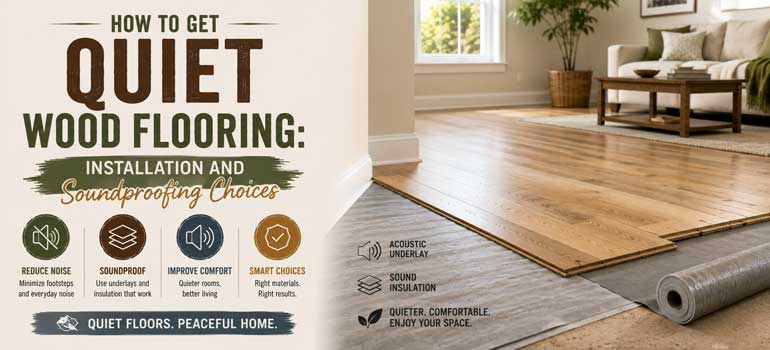
Wood flooring carries an old reputation for being noisy, creaking underfoot and echoing sound between floors, but that reputation largely reflects outdated installation practices rather than a genuine limitation of the material itself. With the right approach at installation and a few sensible additions, a wood floor can be properly quiet, both in terms of squeaking and in how much sound it transmits to the room below.
Why wood floors get noisy in the first place
Two separate issues get lumped together under "noisy flooring," and they have different causes and different fixes. Squeaking is usually mechanical, boards rubbing against each other or against loose fixings as they shift slightly underfoot. Sound transmission, the echo and impact noise that carries to rooms below, is more about the floor's structure and what's underneath it than any single board's condition. Addressing quiet flooring properly means thinking about both.
Acclimatisation reduces movement-related noise
Letting wood boards adjust to a room's temperature and humidity before installation, rather than fitting them straight from delivery, means less expansion and contraction happens after the floor is down. Since board movement is one of the main causes of the rubbing and shifting that leads to squeaking, well-acclimatised boards start out quieter and tend to stay that way longer than boards installed without this step.
Getting the installation itself right
Poorly fitted flooring is one of the most common sources of ongoing squeaks and creaks, and it's largely preventable with proper technique from the start. If squeaking has already developed, it usually points to two boards rubbing against each other, and graphite powder worked between the boards acts as a natural lubricant that reduces this friction noise without needing to lift the floor. Gap filling is worth considering alongside this too, since larger gaps often contribute to the same rubbing noise as boards shift against each other.
Soundproofing underlay for noise between floors
Acoustic underlay, sometimes called soundproofing underlay, sits beneath the flooring and is specifically designed to reduce how much impact noise, footsteps, dropped objects, general movement, transmits to the room below. This matters enough in multi-storey and apartment buildings that some require it as a condition of fitting a wood floor at all, so it's worth checking local requirements before installation regardless of whether noise is a personal priority.
When underlay alone isn't enough
For situations where underlay doesn't sufficiently reduce noise, particularly in older two-storey properties where most of the sound issue originates from the upper level, additional deafening material fitted between the floor structure and the ceiling below offers a more substantial layer of sound insulation. This is a bigger undertaking than underlay alone and usually makes most sense as part of a wider renovation or a new floor installation, rather than being retrofitted to an existing floor on its own.
Simple, low-cost additions that help too
Beyond structural choices, a few everyday additions reduce noise without any major work:
- Rugs and runners in high-traffic areas absorb footstep noise at the source
- Soft furnishings and upholstered pieces help dampen echo in a room with a lot of hard surfaces
- A shoes-free policy reduces both noise and the grit that contributes to squeaking over time
- Felt pads under furniture cut down on scraping and creaking when items are moved
None of these replace proper installation or underlay, but combined they make a noticeable difference to how a room actually sounds day to day.
If your floor is already noisy
For an existing floor that's developed squeaking or noise issues since installation, the fix depends on the cause: isolated squeaks are often resolved with graphite powder or re-securing loose boards, while broader noise concerns might call for adding underlay retroactively or a fuller wood floor sanding and refit if the underlying installation needs correcting.
If your floor's noisier than you'd like, or you're planning a new installation and want it quiet from the start, get in touch for a free quote and we'll advise on the right approach.
Frequently asked questions
Is acoustic underlay always required for wood flooring in flats? This depends on the building and local regulations, but many multi-storey and apartment properties do require it as a condition of installation. It's worth checking before fitting a new floor.
Can existing squeaks be fixed without lifting the whole floor? Often yes. Graphite powder worked between rubbing boards, or re-securing a loose board with a screw, can resolve isolated squeaks without needing to remove flooring.
Does board width affect how noisy a floor is? Wider boards can be more prone to movement-related noise than narrower ones, since they contract and expand more in absolute terms with humidity changes.
Is deafening material worth adding to an existing floor? It's usually more practical as part of a new installation or wider renovation, since retrofitting it under existing flooring is a bigger undertaking than adding underlay alone.
Do rugs actually make a meaningful difference to floor noise? Yes, they absorb footstep impact noise at the source and help dampen general echo, making a genuine, low-cost difference alongside any structural soundproofing measures.