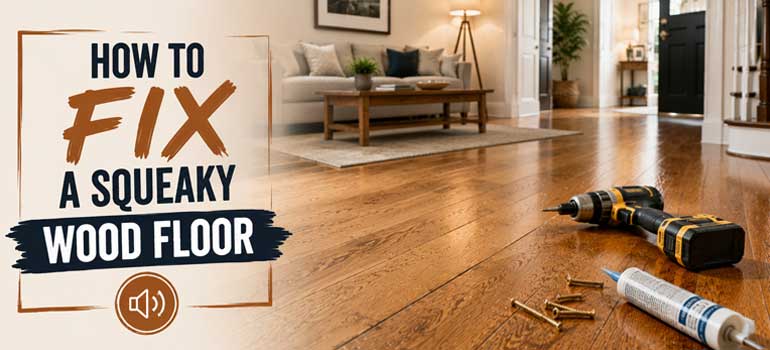
A squeak underfoot doesn't automatically mean something's wrong with a wood floor. Wood is a flexible material that moves naturally with temperature and humidity changes, and some noise is simply part of that movement rather than a sign of damage. That said, a squeak that's constant, worsening, or concentrated in one spot is usually worth investigating, and most causes are straightforward to fix without lifting the whole floor.
Why wood floors squeak in the first place
Squeaking almost always comes down to friction or movement somewhere in the floor's structure, and there are a handful of common culprits.
| Cause | What's happening | Typical fix |
|---|---|---|
| Boards rubbing against each other | Seasonal expansion and contraction leaves small gaps where board edges rub | Chalk or talcum powder brushed between boards to reduce friction |
| Loose fixings | Nails or screws holding boards to joists have worked loose over time | Screwing the board back down securely at the loose point |
| Dried-out subfloor joists | Joists shrink slightly as they age and dry, leaving small gaps under the boards | Shimming or securing from underneath where accessible |
| Nail popping through repeated foot traffic | A nail head gradually rises above the board surface with use | Re-securing the board with a new fixing near the popped nail |
| Board rubbing against a fixed pipe or fitting | Movement of the board against something fixed underneath creates repeated friction | Trimming clearance or repositioning the fixing point |
Locating the source before treating it
One of the more useful things about squeaking is that it's almost always a spot problem, not a whole-floor problem, which means the fix rarely needs to involve the entire room. Walking the floor slowly and noting exactly where the noise happens is the first step, and it's worth doing this at different times, since boards can behave slightly differently depending on humidity and temperature at that moment. If the squeak is directly reproducible by pressing down in the same spot repeatedly, that's a strong sign of a specific loose fixing or friction point rather than general seasonal movement across the whole floor.
Simple fixes that work for most cases
Once the spot is identified, a few approaches handle the majority of squeaks:
- Chalk or talcum powder worked into the gap between boards reduces the friction that causes rubbing noise, and it's a low-cost first thing to try before anything more involved
- Securing loose boards with a screw rather than a nail gives a firmer, longer-lasting fix than the original fixing, particularly where a nail has started to work loose over years of use
- Accessing from below, where there's a basement or crawl space underneath, allows shimming or bracing the joist directly rather than working from the top of the floor, which is often the cleanest fix if it's available
When squeaking points to a bigger problem
Most squeaks are cosmetic annoyances rather than structural warnings, but a few signs are worth taking more seriously: squeaking paired with visible board movement or flex underfoot, a noise that's spread to cover most of the room rather than a specific spot, or squeaking that's started suddenly alongside other signs like sloping or uneven flooring. These combinations can point to subfloor or joist issues that go beyond a simple spot fix, and are worth a professional assessment before assuming a bit of powder or a screw will solve it.
Squeaking on different floor types
Solid wood floors are generally the most straightforward to diagnose and fix, since the boards themselves are the full structural element in contact with the joists below. Engineered wood floors can squeak for similar reasons but sometimes involve the click-lock or glued seams between planks rather than fixings, which needs a slightly different repair approach. Parquet floors squeak less often since blocks are typically bonded directly to the subfloor rather than nailed, but when it does happen it's usually a sign of a bond failing in that specific area, which is worth having assessed rather than treated with powder alone.
If a squeak keeps coming back despite your best efforts, or you're not confident diagnosing the cause yourself, our floor repair service can locate and fix the source properly, and if the floor's due a refresh anyway, it's often worth combining the repair with a wood floor sanding project. Get in touch for a free, no-obligation quote and we'll take a look.
Frequently asked questions
Is a squeaky floor always a sign of damage? No, wood naturally moves with temperature and humidity, and some squeaking is a normal result of that movement rather than a structural issue.
Can I fix a squeaky floor myself? Many cases can be improved with simple fixes like chalk between boards or re-securing a loose board with a screw, though persistent or spreading squeaks are worth a professional look.
Why does my floor only squeak in one specific spot? This usually points to a localised cause, a loose fixing, a rubbing board edge, or friction against something underneath, which is generally easier to fix than a floor-wide issue.
Does squeaking mean my floor needs sanding? Not directly, squeaking is a structural or fixing issue rather than a surface one, so sanding alone won't fix it, though repairs are often combined with a sand if the floor needs refinishing anyway.
When should I call a professional instead of trying a DIY fix? If the squeak is widespread, paired with visible board movement, or hasn't improved after a basic fix like chalk or re-screwing, a professional assessment is worth having to rule out a bigger subfloor issue.