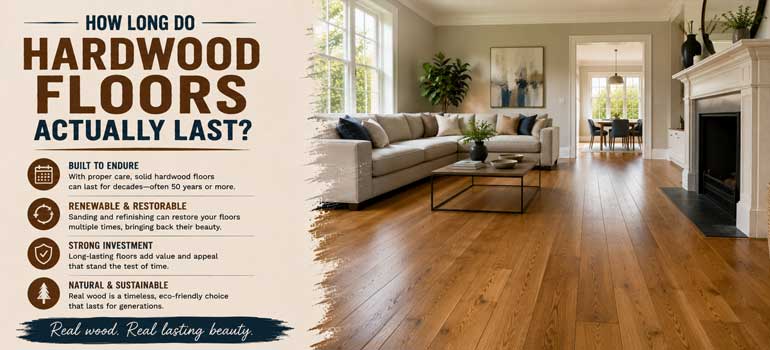
How long a wood floor lasts depends on more than just the species of timber. Construction type, board thickness, and how the floor is cared for over the years all play a real part, and understanding these factors is what separates a floor that lasts decades from one that needs replacing far sooner than expected.
Engineered wood: stability with a defined lifespan
Engineered wood has grown considerably in popularity over the past few decades as an alternative to solid timber, and it's easy to see why: it looks and feels close to solid wood while offering real advantages in stability. Rather than being one continuous piece of timber, engineered boards are built from layers of natural wood arranged in a crisscross pattern and pressed together, a construction specifically designed to resist the shrinking and swelling that moisture and humidity cause in solid wood. This layered structure adapts to indoor conditions more predictably than solid timber does, which is a real practical benefit in properties with fluctuating humidity.
The trade-off is that engineered wood isn't the longest-lasting option among hardwood floor types. Because only the top layer is real hardwood, with a plywood or softwood base beneath it, engineered floors can only be sanded and refinished a limited number of times before that top layer runs out, typically fewer than a comparable solid wood floor.
Solid wood: built for the longest lifespan, with proper care
Solid hardwood floors offer something engineered wood can't match: a single piece of timber running the full thickness of the board, which means far more material available for sanding and refinishing over the floor's life. With proper maintenance and the care solid wood needs, these floors can last for generations rather than decades. Not every wood species performs identically here, but the deciding factor for solid wood longevity often comes down to something less obvious than species alone: how the boards were actually manufactured.
Why tongue and groove thickness matters more than people realise
Older solid wood floors were often installed simply, nailed directly to the subfloor without a finish and without any sanding at all. Modern tongue and groove installation improved on this considerably, giving faster fitting and a more even, uniform layout across the whole floor. But the tongue and groove joint itself reduces the plank's thickness at that specific point, and this detail matters more for long-term durability than most people realise.
| Tongue and groove thickness | What it means for longevity |
|---|---|
| Thinner grooves | Less material remaining after each sand, fewer total refinishes possible over the floor's life |
| Thicker grooves (around ¾ inch is considered strong) | More material to work with, supporting several sanding and refinishing cycles without risking the board's structural integrity |
A thicker tongue and groove profile is worth asking about when choosing new solid wood flooring, since it directly determines how many times the floor can realistically be sanded down the line, effectively the difference between a floor that lasts a few decades and one that lasts a century or more.
What actually shortens a wood floor's lifespan
Beyond construction and thickness, a handful of practical factors determine whether a floor reaches its full potential lifespan or falls well short of it: inconsistent humidity control, which drives the expansion and contraction that stresses boards over years; skipped or delayed maintenance, letting minor scratches and worn finish accumulate into deeper damage; and sanding more aggressively than necessary at each refinish, which uses up material faster than a lighter, appropriately judged sand would.
Getting the most life out of your floor
A few habits meaningfully extend a wood floor's lifespan regardless of whether it's solid or engineered: keeping indoor humidity within a stable range, addressing scratches and worn finish through wood floor sanding before they progress to structural damage, and choosing a lighter maintenance sand over a full sand whenever the floor's condition allows it, preserving more of its total sandable material for future years.
If you're deciding between solid and engineered wood for a new installation, or want an honest assessment of how much life your existing floor has left, get in touch and request a free quote and we'll advise on what makes sense for your specific floor.
Frequently asked questions
Is engineered wood always shorter-lived than solid wood? Generally yes, since only the top layer is real hardwood available for sanding, but a good-quality engineered floor with a reasonably thick top layer can still last many years with proper care.
Why does tongue and groove thickness matter for a floor's lifespan? The groove reduces plank thickness at that specific point, so thicker tongue and groove profiles leave more material available for future sanding and refinishing, directly extending how many times the floor can be restored.
Can poor maintenance really shorten a solid wood floor's life significantly? Yes, letting minor issues like scratches and worn finish go unaddressed lets damage progress further into the wood, often requiring deeper, more material-consuming sanding than earlier attention would have needed.
Does humidity control actually affect how long a wood floor lasts? Yes, significant humidity swings cause boards to expand and contract repeatedly, which stresses the wood over time and can contribute to cupping, gapping and other issues that shorten a floor's useful life.
How can I tell how many refinishes are left in my existing floor? This isn't visible without inspection, so a professional assessment of remaining wood thickness is the most reliable way to know how much sanding capacity a specific floor has left.