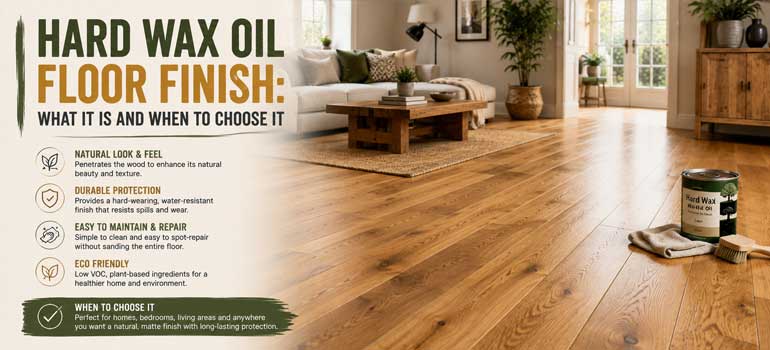
Wood floor finishes used to split neatly into three categories: varnish, oil, and wax. Hard wax oil doesn't sit in any single one of those boxes, it's a combined formula that takes the durability wax is known for and pairs it with oil's ability to soak into the wood and enhance its natural texture, rather than sitting on top of it as a film. For anyone weighing up finish options during a wood floor sanding project, it's worth understanding how it actually differs from more familiar choices.
How it differs from a film-forming finish
Lacquers, including options like Bona Traffic HD or Junckers HT700, work by forming a protective film across the top of the wood. That film is tough and gives an even, consistent sheen, but it does sit between you and the timber itself, so some of the wood's natural texture is masked underneath the coating. Hard wax oil takes the opposite approach: it penetrates into the wood's pores rather than sitting on the surface, which means water and dirt are still kept out effectively, but the floor's actual grain and texture stay visible and touchable, not sealed under a layer of plastic-like coating.
Why it holds up well despite not forming a film
It might seem counterintuitive that a finish without a surface film could still protect a floor well, but the mechanism is different, not weaker. By filling the wood's pores rather than coating over them, hard wax oil creates resistance to moisture and dirt from within the wood structure itself. This also has a practical advantage over time: because there's no continuous surface film to crack or peel, localised wear in one area can often be spot-treated with a fresh coat of oil in just that section, without needing to strip and refinish the whole floor the way a damaged lacquer sometimes requires.
What the finish actually needs to stay looking good
Hard wax oil isn't a one-and-done finish the way some lacquers are marketed to be. It's designed around a light annual recoat, a maintenance oil applied roughly once a year, which keeps the protection topped up and, notably, the floor tends to build a richer, warmer sheen the more years of care it gets. This is a genuine trade-off worth being honest about: it asks for more regular light attention than some lacquers, in exchange for an easier full-strip-and-refinish cycle and a finish that actually improves with age rather than just gradually wearing down.
Where hard wax oil tends to suit best
| Consideration | Hard wax oil | Standard lacquer |
|---|---|---|
| Surface feel | Natural, matte, wood grain is tactile | Smoother, more uniform film |
| Maintenance | Light annual recoat recommended | Less frequent, but harder to spot-repair |
| Wear resistance | Good, and spot-repairable | Very good, especially traffic-rated products |
| Best suited to | Living spaces where natural texture matters | High-traffic commercial or very busy family homes |
Neither is objectively better; the right choice depends on how the room is used and what look you're after. Homes prioritising an authentic, natural wood feel, particularly on species with attractive grain patterns, tend to suit hard wax oil especially well, while heavy commercial traffic or households wanting the lowest possible maintenance often lean toward a traffic-rated lacquer instead.
Which wood species and floor types it suits
Hard wax oil works across essentially all real wood flooring types, solid wood, engineered floors, and parquet alike, though it tends to be chosen most often for floors where the wood's natural grain and character are a genuine selling point rather than something to be smoothed over. Reclaimed or characterful timber, where knots, grain variation and colour differences are part of the appeal, often looks its best under a finish that doesn't flatten that character under a glossy film.
Deciding if it's right for your floor
If you're planning a wood floor recoating or a fresh sand and finish, it's worth discussing both hard wax oil and lacquer options with a professional before committing, since the right choice really does depend on your household's routine and how much upkeep you're realistically going to keep on top of. Get in touch for a free, no-obligation quote and we'll talk through which finish suits your floor and how it's used.
Frequently asked questions
Does hard wax oil finish need more maintenance than lacquer? It benefits from a light annual recoat, which is more frequent attention than some lacquers need, though each recoat is quick and doesn't require sanding the whole floor down.
Can hard wax oil be spot-repaired if one area gets damaged? Yes, this is one of its practical advantages. Because it doesn't form a continuous surface film, a worn or damaged patch can often be treated with fresh oil in just that area.
Is hard wax oil suitable for high-traffic commercial spaces? It can be used commercially, but very high-traffic areas often do better with a traffic-rated lacquer, which needs less frequent attention despite being harder to spot-repair.
Does hard wax oil change the appearance of the wood? It enhances rather than masks the wood's natural texture and grain, giving a more matte, tactile surface compared to the smoother, more uniform look of a film-forming lacquer.
Is hard wax oil suitable for all wood species? Yes, it works across solid, engineered and parquet floors in most wood species, and tends to be particularly popular on timber with distinctive grain or character worth showing off.