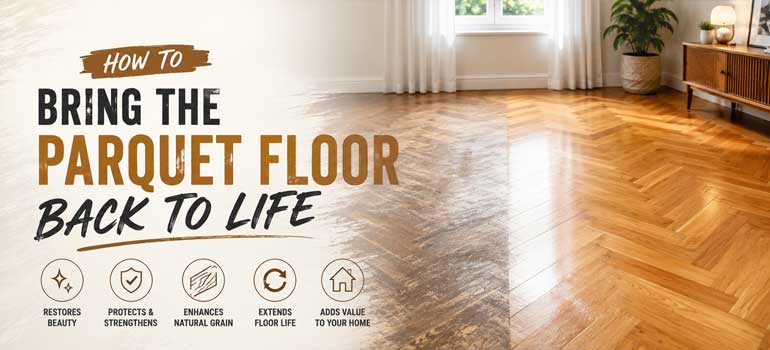
A tired parquet floor, dull, gappy, with a few loose or cracked blocks, is usually not a floor that needs replacing. Parquet is solid hardwood cut into small blocks and laid in a pattern, and because each block is a separate piece of wood, damaged sections can often be treated individually rather than ripping out the whole floor. Restoring it properly does take more care than a standard plank floor though, because the pattern itself is part of what you're protecting.
Why parquet floors develop problems over time
Parquet blocks are traditionally bonded directly to a concrete or plywood subfloor rather than fixed the way plank flooring is, which makes them sensitive to what's happening underneath. Common causes of damage include:
- Moisture in the subfloor, which can loosen the adhesive bond and cause blocks to lift or "tent" at the joints
- Years of foot traffic wearing through the finish, leaving bare wood exposed to staining and further wear
- Seasonal humidity changes, which cause blocks to expand and contract, sometimes opening gaps between them
- Poor original installation, where blocks weren't properly bonded or the subfloor wasn't level, dry or clean before laying
- General wear and tear, including scratches, cracked blocks, and dents from heavy furniture or dropped objects
Spot repair or full restoration: how to decide
| Spot repair | Full restoration | |
|---|---|---|
| Best for | A handful of damaged or loose blocks in an otherwise sound floor | Widespread wear, extensive gaps, or damage across most of the floor |
| What it involves | Removing and replacing only the affected blocks, matched to the existing pattern, then blending the finish | Full sand back to bare wood, repairs where needed, then complete refinishing |
| Disruption | Minimal, usually a small section out of use | The whole floor is out of use until finish has cured |
| Risk if done poorly | Mismatched grain or colour breaking the pattern | Uneven sanding across varying block grain directions |
Why sanding parquet is different from sanding plank floors
Parquet blocks are laid with their grain running in different directions from one block to the next, that's what creates the herringbone, basketweave or chevron pattern in the first place. A machine that sands in a single direction, the way it would on a plank floor, will cut with the grain on some blocks and against it on others, leaving an uneven, patchy finish. Parquet sanding needs to be done in stages and at angles that respect the pattern, which is why it's not a job to learn on your own floor.
Replacing damaged or missing blocks
When individual blocks are cracked, badly stained or missing altogether, the repair only works if the replacement block matches the surrounding wood in species, grain direction and, ideally, age and colour. A mismatched block stands out immediately once the floor is refinished, even if the repair itself is technically sound. For older floors, this sometimes means sourcing reclaimed parquet blocks rather than new-cut timber, since new wood rarely matches decades of natural colour change straight away.
What to expect from a professional parquet restoration
A proper restoration typically works through the floor in this order:
- Assess which blocks are loose, cracked, or beyond repair, and check subfloor moisture where lifting is present
- Replace or re-bond any damaged blocks before sanding starts
- Sand the floor in stages that account for the changing grain direction across the pattern
- Fill any remaining gaps between blocks
- Apply the chosen finish, lacquer or oil, evenly across the full pattern
If you're dealing with a few loose blocks or a floor that's lost its shine across the board, our parquet floor sanding service and parquet floor repairs team can assess what the floor actually needs before recommending a full restoration. Get in touch for a free, no-obligation quote and we'll tell you honestly whether spot repairs will do the job.
Frequently asked questions
Can loose parquet blocks be fixed without replacing the whole floor? Yes, in most cases. Loose blocks can be lifted, re-bonded to the subfloor, and blended back into the pattern without disturbing the rest of the floor.
Why do gaps appear between parquet blocks? Gaps usually open up because of seasonal humidity changes causing the wood to contract, or because the original installation wasn't fully bonded to the subfloor. Gaps can be filled during restoration.
Is it possible to match new blocks to an old parquet floor? It's possible but not guaranteed with new-cut timber, since old wood has usually changed colour over time. Reclaimed blocks of a matching species and age give the closest match.
How many times can a parquet floor be sanded? This depends on the thickness of the individual blocks, which is generally less than a solid plank floor. A professional assessment before sanding will confirm how much material the blocks can safely lose.
Does moisture damage always mean the blocks need replacing? Not always. If the wood itself hasn't warped or rotted, drying out the subfloor and re-bonding the affected blocks is often enough. Replacement is usually only needed where blocks have cracked or badly cupped.